
Operational Excellence is defined as a business philosophy and strategic approach that focuses on continuous improvement across all aspects of the organization to achieve a competitive advantage. This contrasts with Operations Management, which is a functional discipline focused on the day-to-day activities of a business to efficiently produce goods and services. The scope of this article is limited solely to OPEX technology and tools, as addressing technology in functional Operations Management is an extremely complex and organization-specific discipline.
Applying technology in operations is not a new concept. In the Toyota Production System (TPS), Jidoka has been a key concept of “autonomation” – automation with a human touch. This philosophy remains relevant today with technologies such as Robotic Process Automation (RPA) and Artificial Intelligence (AI), where technology detects issues and root causes, which are then often resolved by human intervention.
OPEX generally consists of several pillars – foundational principles that should guide the organization in achieving sustainable performance improvement, a customer-centric approach, and long-term value creation. Let’s explore which tools and technologies can be applied within each pillar.
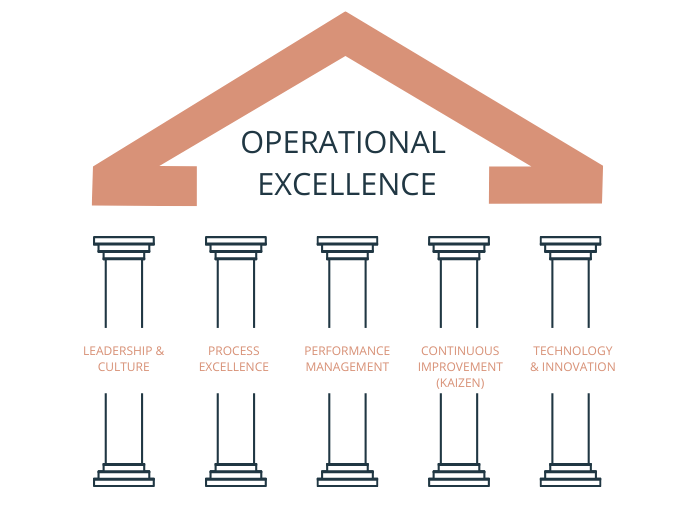
1. Leadership and Culture
Leadership and culture are important aspects of OPEX, as they unite people around a purpose and vision, fostering a culture of empowerment, ownership, and continuous improvement. The most commonly used tools and technologies include:
- Collaboration Tools: Tools like Teams, Slack, and project management applications such as Asana and Trello facilitate communication and coordinated efforts.
- Learning and Development (L&D) Tools: Continuous development of employees and leaders is paramount for continuous improvement and customer focus. Platforms such as Udemy Business, TalentLMS, and 360Learning are highly effective for learning content. However, these tools cannot replace specific, job-related process training and required certifications.
2. Process Excellence
Process Excellence is arguably the most critical pillar in OPEX. It relates to the design and improvement of any process, from the simplest linear sequence to the most complex, multi-step operations.
In this context, it’s important to differentiate between a process and a workflow, as these definitions are sometimes interchanged:
- A process is a series of steps to achieve a specific output – WHAT is done. It is repeatable, measurable, and often standardized.
- A workflow is the sequence and flow involving people, systems, and tools needed to complete a process – HOW it is done.
In recent years, Business Process Management (BPM) technology has developed rapidly, from simple process design tools to complex workflow orchestration and management platforms.
- Process Design and Documentation Tools: Tools like Signavio, Process Maker, and Appian contribute to simple process design, complex process simulation, and documentation. Tools like OpenText ensure diligent BPM documentation, and applications such as Asana can translate complex Standard Operating Procedures (SOPs) into detailed Step-by-Step Job Element Sheets, rapidly decreasing training lead time.
- Workflow Orchestration and Automation: Once a process is designed, workflow orchestration and management tools are applied to design detailed workflows at the task level (who is doing what, how, and when) and subsequently automate eligible data flows. UiPath, Camunda, Prefect, Pega, and Apache Airflow are common tools for orchestrating and automating complex workflows. Many of these tools apply AI in designing and monitoring workflow performance and identifying exceptions.
The benefits of process excellence tools are substantial:
- Reduced Lead Time: Visualizing and analyzing bottlenecks, and partly automating steps, significantly reduces Process Lead Time (PLT) and Total Lead Time (TLT). It makes the process visible, enabling rapid action against bottlenecks.
- Increased Efficiency and Reliability: Improving task sequencing and reducing manual errors enhances efficiency.
- Cost Optimization: Intelligent scheduling and dynamic resource allocation prevent overprovisioning, ensuring resources are used only when and where needed.
- Consistency and Standardization: Ensures tasks are performed uniformly, creating opportunities for Continuous Improvement due to increased visibility of process design and synchronized workflows.
3. Performance Management
Performance management, as an OPEX pillar, refers to the structured approach organizations use to monitor, evaluate, and improve performance at all levels – individual, team, and organizational – to ensure alignment with strategic goals and continuous improvement. This includes:
- Design of KPIs to align organizational goals.
- Continuous Monitoring with real-time dashboards and analytics to track performance, progress, and trends, enabling proactive adjustments rather than reactive fixes.
- Building an organizational learning culture and improving general planning based on performance gaps.
Technology has rapidly developed in the realm of performance management:
- Business Intelligence (BI) Tools: Tools such as Power BI, Tableau, and Qlik Sense are extremely powerful for data and performance visualization, enabling real-time monitoring and data-driven decisions. AI layers applied in BI tools further enhance capabilities by predicting trends and potential operational risks, facilitating proactive decision-making.
- OKR & Goal Tracking Tools: Weekdone, Koan, and GtmHub specialize in designing Objectives and Key Results (OKR) frameworks to drive transparency and accountability. The Objective (O) is what you want to achieve (significant, concrete, and action-oriented). The Key Results (KR) benchmark and monitor how you achieve the objective (specific, time-bound, measurable, and verifiable outcomes). Organizations like APQC (American Productivity & Quality Center) provide invaluable benchmarking data and best practices from thousands of organizations across 45 industries.
4. Continuous Improvement (Kaizen)
Continuous Improvement (Kaizen) is the cornerstone of Operational Excellence. It enables and empowers everyone in the organization to contribute incremental improvements, enhance processes, and achieve efficiency.
With the application of technology, a new term emerges: Digital Kaizen. This applies the same principles in an enhanced and more efficient format, overcoming a common failure of traditional Kaizen – the cumbersome structured submission of improvement ideas. Digital Kaizen simplifies the process, boosting employee engagement.
- Capturing and Logging Core Ideas: Any workflow orchestration tool can be used to capture, follow, implement, and validate benefits. Jira and Service Now, if already implemented, are highly effective. Using Kaizen Workflows creates transparency, tracks progress, and even forecasts the overall financial benefits of implemented improvements, while establishing a structure for priority and urgency.
- Collecting and Analyzing Real Data: Data analytics, Process Mining, and AI enable the identification of improvement areas, potential bottlenecks, and waste. Every improvement idea can be easily calculated into a measurable benefit. Example: Reducing the process time (PT) in process X by applying measure Z by 5 minutes per unit, across 2,000 units, yields a benefit of 10,000 minutes (or 166 hours), which can be used for capacity replanning and forecasting.
Challenges with Applying Technology in Operational Excellence
The rapid development of technology, accelerated by recent AI adoption, is moving us toward the concept of Operational Excellence 2.0. However, as with any transformation, certain challenges must be addressed:
- Integration Complexity: Data generated by one process/system is often needed by another system downstream or upstream. Many companies rely on legacy systems, making the integration of OPEX tools as an overlay extremely challenging. A common issue is the lack of visibility into the overall business and IT architecture, which contributes to failed adoption.
- Adoption Challenges and Change Management: These are well-known reasons for failing to realize benefits from new technologies. A company can implement the best-in-class workflow system, but if employees do not enter orders or cases into the workflow, it will not only fail to deliver benefits but will also create downstream business difficulties. Early involvement of users, combined with proper training and communication, is paramount for successful technology adoption.
- Data and Technology “Blindness” (Over-reliance): Looking at hundreds of KPIs in different colors from hundreds of processes can lead to a proxy understanding of reality, neglecting the human factor, culture, and strategic alignment. Data is only as good as the process generating it. While technology drives efficiencies, preventing over-reliance requires strong leadership, strategic alignment, and a high level of coordination.
- Skills and Knowledge Gap: Operational Excellence 2.0 will fundamentally change traditional organizational roles. Future Operations and OPEX managers are expected to understand the technology and overall business and IT architecture. Similarly, traditional IT managers are moving toward becoming Business Architects and integrators. Not every organization currently possesses the skills required to adopt, scale, manage, and optimize these new technologies.
Summary
The rapid development of technology and AI creates enormous opportunities for enhancing the current Operational Excellence concept, yielding substantial business benefits and improved business architecture integration. However, achieving this requires an enhancement of organizational capabilities to adopt, scale, manage, and optimize the new technology.
Many organizations operate with complex (often legacy) business processes and system architecture, which makes new technology adoption cumbersome. Operational Excellence has been a powerful concept on the corporate agenda for decades, and it will continue to exist as a vital framework for optimizing and evolving business models. Applying a layer of technology will make it even more powerful, but success will require a better understanding and more systematic thinking about the overall business architecture.