
Many Shared Service Centers estimate that 60–65% of repetitive transactional work could be automated. This aligns with current Global Business Services (GBS) benchmarks from Hackett Group, KPMG, Deloitte, and ScottMadden, where leading organizations report automation coverage between 50% and 70% across finance and operational domains. Yet despite modern ERP landscapes and service platforms, execution remains heavily manual in many environments.
The gap between ambition and execution persists. Closing it requires more than technology. It requires clarity on where friction sits, what digital leaders do differently, and how to scale AI responsibly.
Where execution breaks down in practice
Most SSCs do not lack systems. They lack deep orchestration between systems.
Typical friction points include:
- Manual document validation. Invoices, vendor statements, contracts, and attachments require human review due to inconsistent formats and limited document intelligence. Vendor statements are reconciled manually against ERP data to detect missing invoices.
- Manual case triage and analysis. A significant share of IT and HR service tickets are read, interpreted, categorized, and routed manually. Agents analyze free text descriptions, search knowledge bases, determine priority, and draft responses without intelligent assistance. Recurring incidents are rarely analyzed systematically.
- Swivel-chair reconciliation across platforms. Users open multiple systems to reconcile purchase orders, goods receipts, service confirmations, invoices, and ticket data. Financial postings may sit in one system, procurement data in another, and case information in a third. IT service management (ITSM) cases often require ERP validation before resolution, yet data is not surfaced automatically.
- Low touchless transaction rates. Free text purchase orders, manual checks, and fragmented vendor setups reduce transparency and slow execution.
These are not technology failures. They are orchestration gaps. Many SSCs are process mature. Fewer are integration mature.
Why Shared Service Centers are structurally ready
Despite the friction, SSCs have strong foundations:
- Documented and standardized processes
- Mature ERP and enterprise platform landscapes (e.g., SAP S/4HANA, Oracle ERP Cloud, Microsoft Dynamics 365, Ariba, Jaggaer, Coupa, VIM, Workday)
- Established ITSM and service management platforms
- Centralized governance and KPI structures
- Continuous improvement of capabilities
This structural maturity creates a favorable starting point.
The next step is not adding isolated automation tools. It is defining a structured roadmap that integrates AI capabilities, redesigned processes, and a deliberate people transition.
That transition includes new role definitions and upskilling for AI augmented work. Technology, workflows, and workforce capabilities must evolve together rather than in isolation.
From task automation to cross-platform orchestration
Traditional automation removes repetitive clicks. It does not remove the need for people to manually assess, compare, and decide what to do next.
Generative AI and multi-agent capabilities introduce a different layer of value: they interpret context, validate data across systems, and support exception handling.
In an SSC context, this typically means:
- Intelligent intake classification for finance, procurement, HR, and IT requests
- AI-based document understanding for invoices, contracts, and attachments
- Automated ticket summarization and routing in service environments
- Cross-system validation between ERP, procurement, expense, and ITSM platforms
- Predictive identification of reconciliation mismatches
The shift is from automating tasks to orchestrating decisions.
A structured 6-Phase Journey
Carve recommends a strategic roadmap from initial discovery to sustainable AI operations, designed to deliver measurable impact across Group functions.
- A 12-week structured program covering Discovery, Proof of Concept, and Design for Scale.
- A clear stop/go decision after 6 weeks, based on validated PoC results, data readiness, and organizational capacity.
- Scaling only when architecture, governance, and benefit case are proven.
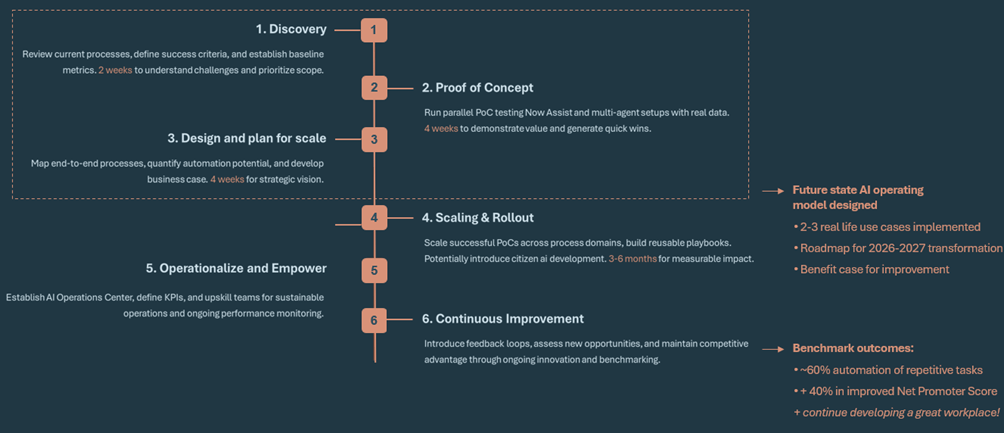
Figure 1: A strategic roadmap from initial discovery to sustainable AI operations, designed to deliver measurable impact across Group functions.
We recommend starting with a 12-week sprint focused on the first three phases:
- Discovery (2 weeks): Identify high-value AI opportunities and assess data formats, integration maturity, ticket taxonomies, master data quality, and control environment readiness
- Proof of Concept (4 weeks): Build and test two to three use cases in live workflows. Measure accuracy uplift, cycle-time reduction, backlog improvement, or touchless-rate increase. Validate architecture, data access, and clear rules for data use, security, and oversight.
- Design for Scale (4-6 weeks): Quantify automation potential, define the AI operating model, design governance and integration architecture, and build a roadmap aligned with annual planning cycles.
Phase 4–6: Deploy, operationalize, optimize – Scale validated use cases, assign clear ownership of automated solutions, define operational KPIs, and establish continuous improvement.
This approach ensures early validation while building a solid foundation for scaling.
Where impact can be realized quickly
Early pilots with measurable impact often include:
- Finance (R2R): GenAI-driven automated variance explanations based on trial balance and P&L data, and AI-assisted reconciliation that matches ledger and subledger entries and flags discrepancies for review. 40–60% reduction in manual reporting effort.
- Procurement (P2P): AI-assisted intake-to-PO orchestration and supplier query assistants. Shorter request-to-order cycles and reduced manual classification.
- HR services: Virtual assistants and automated document generation. Up to 30% release of HR service capacity.
- IT service desk: AI-based ticket summarization, categorization, and routing. Higher first-contact resolution and lower backlog.
These initiatives leverage existing platforms more intelligently rather than replacing them.
What digital leaders achieve
Digital World Class GBS organizations operate at approximately 29% lower cost per transaction (Hackett Group) and demonstrate materially higher productivity.
However, cost efficiency is only part of the outcome. Digital leaders redesign how work is structured.
Future-state SSC organizations typically divide work into three execution layers:
1. Human-led work
Strategic decision-making, stakeholder advisory, governance shaping, and complex exception handling. Controllers, HR partners, and IT leads focus on insight and judgment rather than transaction handling.
2. AI-augmented work
Generative AI supports drafting, summarizing, recommending next actions, and guiding users across Finance, HR, IT, and Procurement. Humans remain accountable but operate with higher speed and consistency.
3. Fully automated flows
Agentic workflows and API-driven automation validate, match, route, reconcile, and synchronize data across ERP, procurement, expense, and ITSM platforms with minimal intervention.
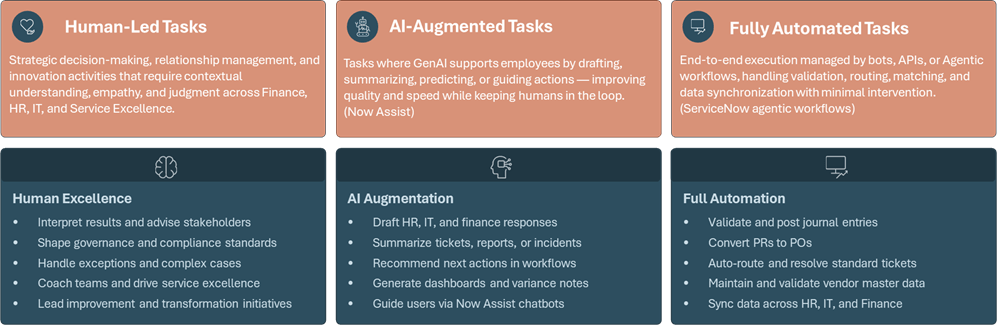
This redesign produces measurable structural outcomes:
- 50–70% automation of repetitive transactional work
- Reduced cost per transaction by roughly one third (29%), according to Hackett’s Digital World Class GBS benchmark
- Improved service responsiveness and internal satisfaction
- Reduced dependency on manual reconciliation
- Scalability without proportional headcount growth
AI shifts SSCs from reactive processing hubs to intelligent, orchestrated service engines – freeing capacity to take on more advanced analytical, advisory, and value-adding tasks for the broader organization.
Prerequisites for success
AI transformation in SSCs is not only a technology initiative. It is a coordinated shift in governance, processes, and people.
Critical enablers include:
- Clear system ownership across ERP, procurement, expense, and ITSM landscapes
- Master data and taxonomy alignment between Finance and Procurement
- API-based integration capabilities
- Formal AI governance including validation checkpoints and human-in-the-loop controls
- A structured people transition, including new role clarity, targeted upskilling, and leadership.
Carve’s approach combines technology enablement with structured change management, ensuring robust governance, leadership commitment, and targeted upskilling. When cultural readiness and technical readiness progress together, organizations unlock sustainable impact.
AI transformation is not only a technology shift. It requires new skills and a culture that embraces continuous learning. As employees learn to work alongside AI and take on new roles, SSC’s can also strengthen their position as a great place to work. AI-supported processes reduce repetitive tasks and help attract and retain employees with the right competencies.
Call to Action
SSCs are ready, technology is available, and the benefits are proven. What is needed now is focus, speed, and a structured approach. Initiating a 12-week sprint will deliver visible wins and establish the foundation for a future where AI drives efficiency, agility, and innovation.